
Valuing Personal Data in the Bitcoin Era
By Staff · Sep 7, 2026 · 3 views
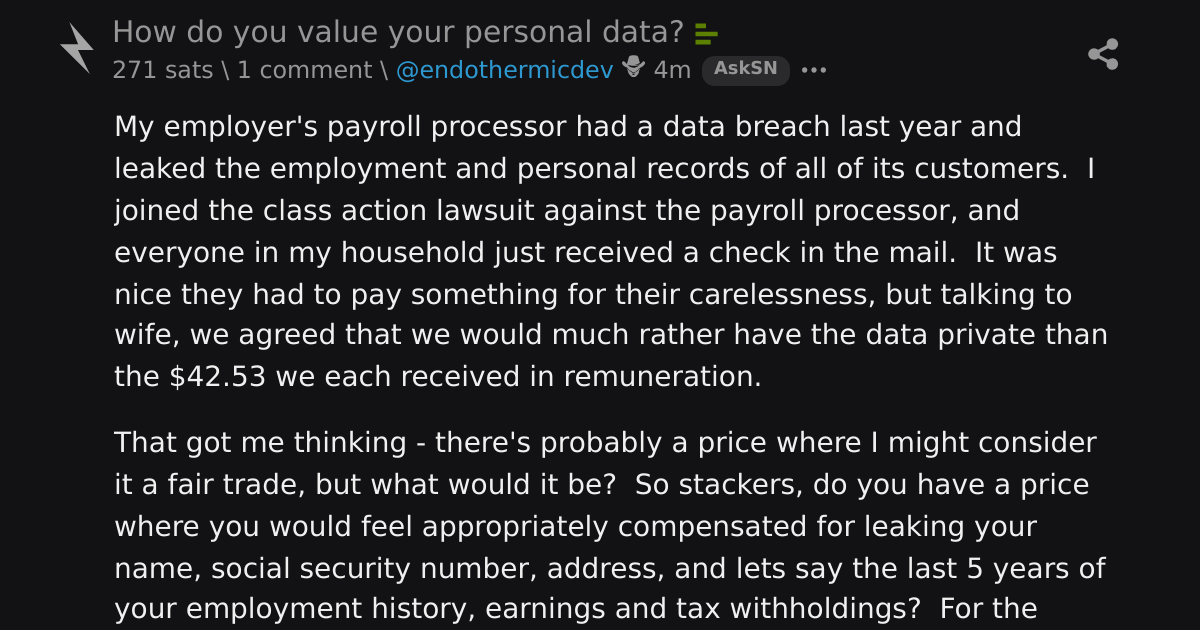
In the digital age, personal data has become a valuable asset, often traded by companies without the explicit consent of individuals. However, with the advent of Bitcoin and the Lightning Network, there is a growing conversation about how individuals can reclaim control over their personal data and its inherent value.
Bitcoin, as a decentralized digital currency, offers a model for financial sovereignty that can be extended to personal data management. The Lightning Network, a second-layer protocol on top of Bitcoin, enhances this capability by enabling fast and low-cost transactions. This infrastructure can potentially be used to create systems where individuals can monetize their data directly, ensuring that they receive fair compensation for its use.
By leveraging Bitcoin's decentralized nature, users can protect their privacy and decide who accesses their data and under what terms. This shift could lead to a more equitable digital economy where personal data is not just a commodity for corporations but a resource that individuals can control and benefit from.
The discussion around valuing personal data in the context of Bitcoin and the Lightning Network is still evolving, but it represents a promising step towards a future where individuals have more power over their digital identities.